Beacon Blog
AI in Your AMS Search: Where It Helps, Where It Fails, and How to Use It Wisely

If your association is considering a new AMS, we understand there could be a strong temptation to simply ask ChatGPT or another AI tool “Which AMS is best for us?”
It feels fast.
It feels efficient.
It feels like skipping the messy parts of selection.
But here’s the truth: It could get you half way there.
AI can be incredibly useful during an AMS search, but only in certain parts of the process.
And if you rely on it for the wrong steps, you can easily walk away with a shortlist that looks credible on the surface but is wildly misaligned with your needs.
This post breaks down where AI genuinely helps, where it falls apart, and how to use it productively without risking a six-figure mistake.
The Big Misconception: “AI Can Just Pick the AMS for Us”
Most associations start with one assumption: if AI can write grants, analyze data, or pass the bar exam, surely it can sort through AMS vendors and give a solid recommendation.
The problem? AI doesn’t understand the AMS market the way associations need it to.
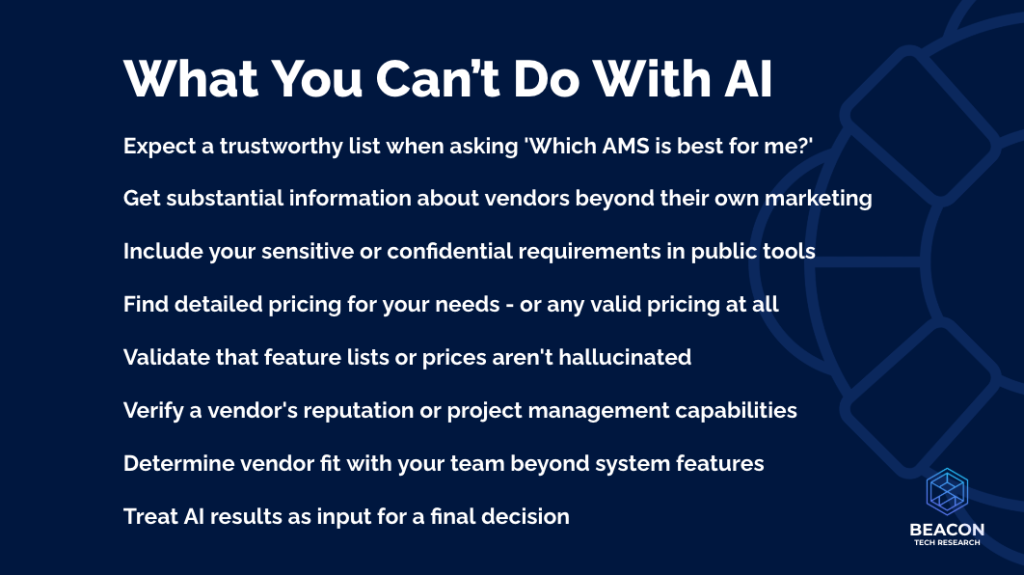
Those limitations aren’t small. They strike at the core of what makes AMS selection difficult:
- AI can’t confirm vendor claims. It doesn’t know which features are real, which prices are current, or which statements are just marketing copy.
- It can’t account for your culture, your workflows, or your capacity for change.
- It weights all inputs equally, even when your top priorities should carry far more weight than minor requirements.
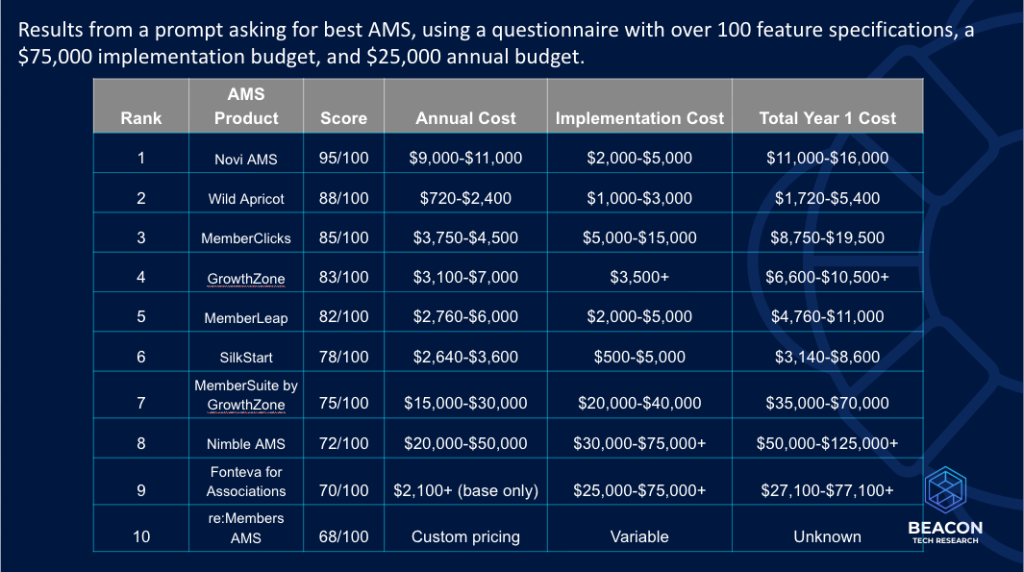
- It can hallucinate entire feature sets, prices, and vendor capabilities with utter confidence.
In other words: it can sound right, but be wrong.
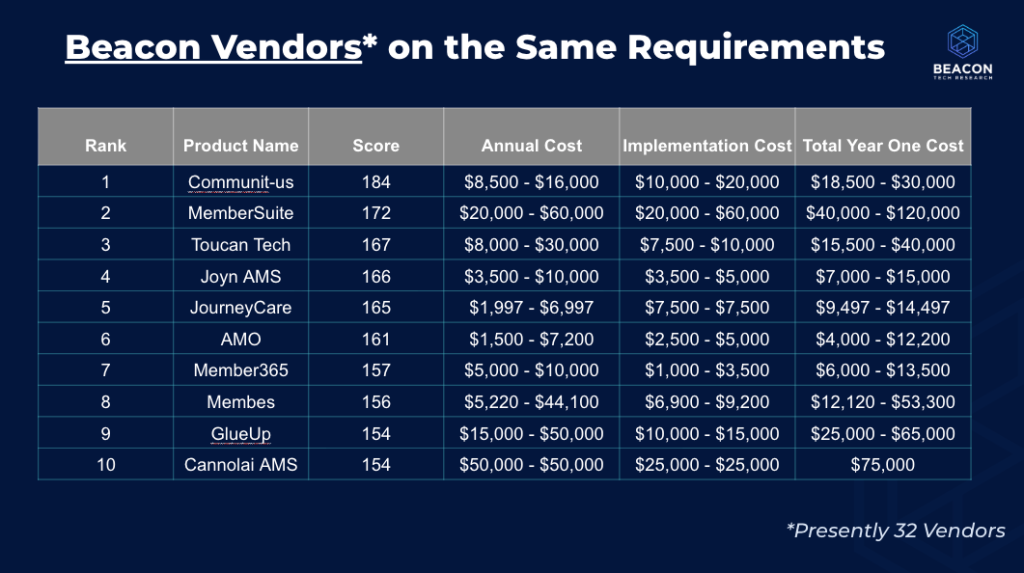
That’s why using AI to generate a “best AMS” list is a non-starter.
But…AI Is Still a Powerful Tool When You Use It for the Right Tasks
Now for the good news: AI can make the AMS search smoother, faster, and far less time-consuming…if you apply it to the parts of the process that don’t require judgment, verification, or stakeholder balance.
These uses matter because they help your team reclaim hours normally spent on administrative tasks, while still keeping human insight at the center.
Let’s break it down across the four essential stages of AMS selection.
Stage 1: Requirements Gathering
This is one of the most human parts of the entire process. And it’s important because the AMS market is evolving. It requires conversations, nuance, and capturing both qualitative and quantitative needs.
AI can help:
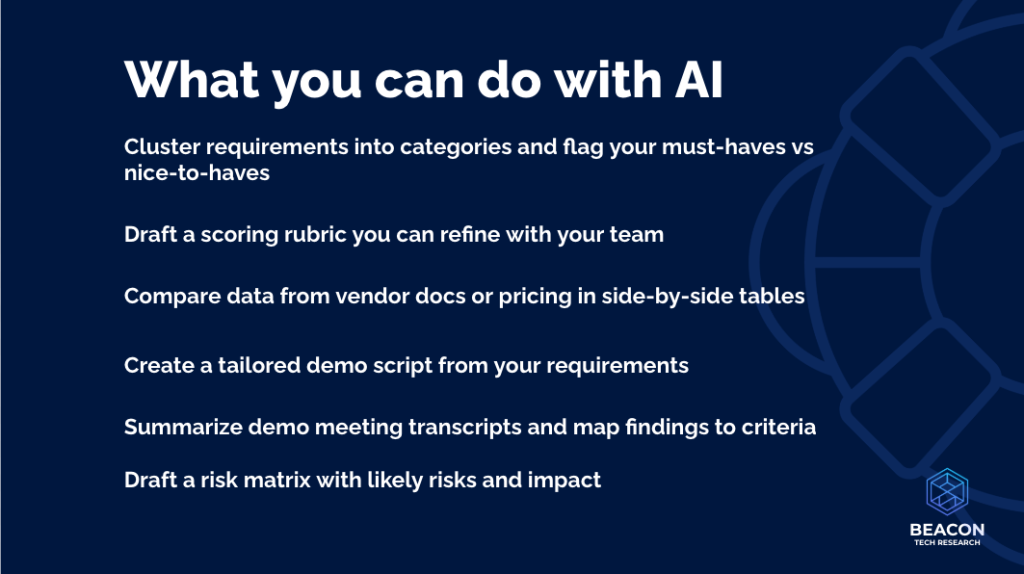
- Summarize meeting transcripts into structured requirement sets.
- Categorize requirements into functional groups.
- Draft early versions of your requirements document.
- Flag inconsistencies or overlaps in what different staff want.
But AI cannot:
- Tell you which voices matter most in your decision.
- Prioritize competing needs.
- Understand the deeper operational problems behind an expressed “feature request.”
This is where human interviews, strategic clarity, and surfacing real pain points are essential.
Stage 2: Proposal Review
Once the proposals arrive, AI becomes much more useful. It’s excellent for:
- Creating side-by-side tables comparing vendor responses.
- Summarizing long proposals into key differences.
- Organizing pricing information (with human verification).
Where AI falls short:
- Distinguishing “sales speak” from real capability.
- Spotting what pricing doesn’t include.
- Evaluating vendor methodology or long-term compatibility.
AI can get you organized. But only humans can determine whether a proposal is realistic or glossing over gaps.
Stage 3: Demonstrations
AI can make demos dramatically better—before and after.
What AI can do well:
- Draft tailored demo scripts based on your requirements.
- Create scoring rubrics for your team.
- Summarize demo notes and map feedback to criteria.
What only humans can judge:
- How a vendor behaves under real questions.
- Whether the system genuinely works for your workflows.
- Team reactions to usability, culture, and rapport.
This is where the “human side” becomes mission-critical.
Stage 4: Final Decision
Your decision-making process needs two things AI cannot provide: judgment and weighting.
AI can help consolidate:
- Scoring
- Pricing comparisons
- Proposal summaries
It can even help you draft your business case for the board.
But it cannot:
- Understand your risk tolerance.
- Interpret staff readiness.
- Weigh organizational politics, governance expectations, or stakeholder alignment.
- Sense red flags in vendor behavior.
Ultimately, AMS decisions succeed or fail based on fit—not just features—and fit is a deeply human assessment.
The Critical Reality: AI Is a Tool, Not a Decider
This is the message most associations need most right now:
AI enhances the AMS selection process, but only when humans remain in charge of strategy, judgment, culture fit, and verification.
AI makes the process faster.
It makes documentation more organized.
It reduces time spent on administrative tasks.
But it cannot replace the conversations, context, and nuance that AMS decisions depend on.
Where Beacon Fits Into This
🎥 WATCH: Our Webinar Exploring this Topic
If your team is exploring how AI fits into your AMS search, Beacon Tech Research was built for this moment.
We take the parts of the process where AI can help and pair them with the parts where human expertise is irreplaceable.
Our platform uses structured, validated data (not scraped marketing content), and our advisors guide your team through demos, requirements, and final decision-making with clarity and confidence.
AI speeds up the work. Beacon makes the work right.
If you’re planning an AMS search in the next year, we can help you blend human judgment with the best of AI without sacrificing accuracy, nuance, or fit.
Start Smart. Choose Wisely.
Get Started with Beacon Today!
Want Help Finding Your Next AMS?